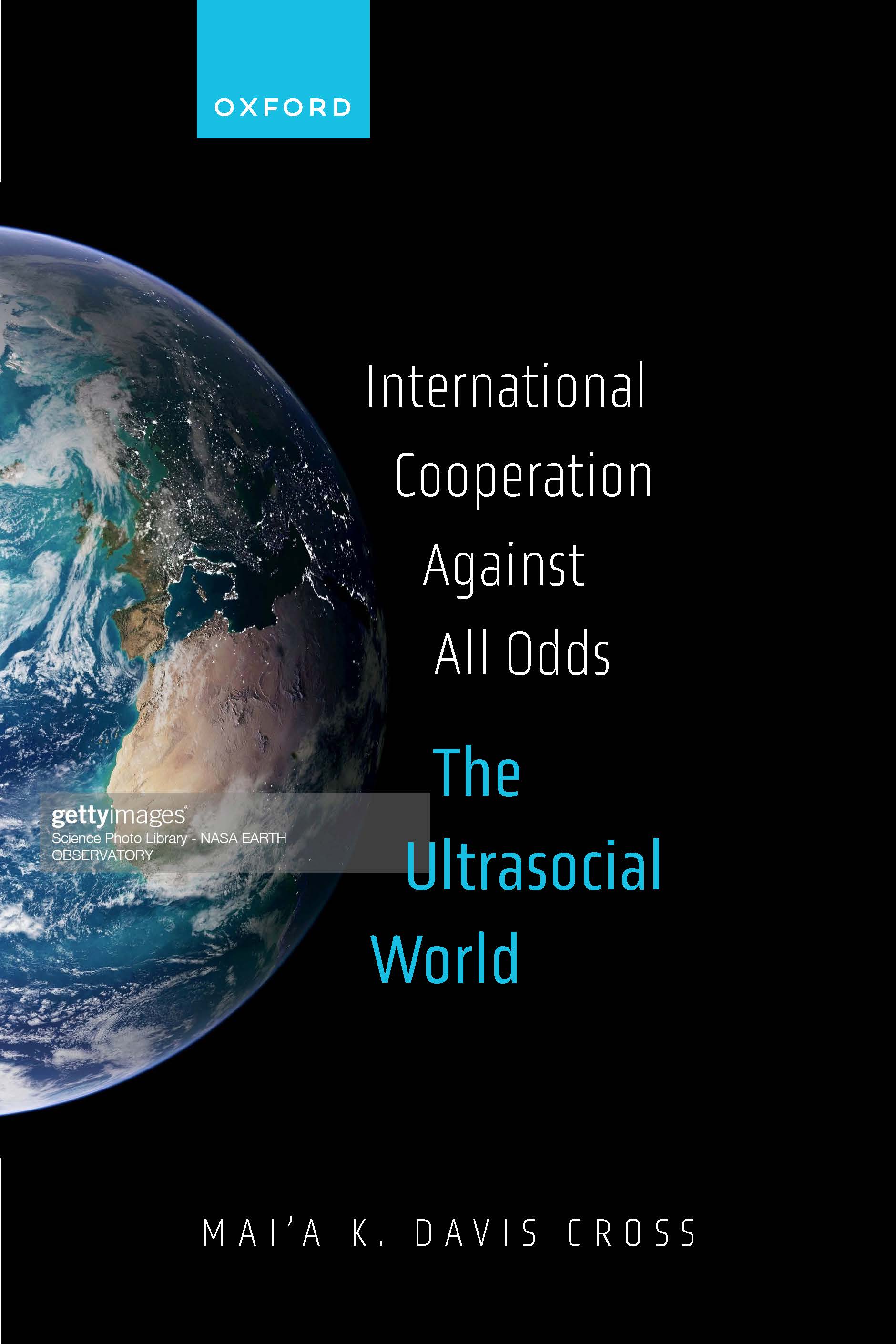
International Cooperation Against All Odds: The Ultrasocial World (Oxford University Press, 2024) recasts how we understand international relations through an examination of how the human evolutionary predisposition to be “ultrasocial” as a species impacts which political ideas succeed, transform, manipulate, and inspire on a global scale. At a time when pessimism about our current world order is at an all-time high, this book overturns widespread assumptions that international relations is mainly about conflict, power, and national self-interest. In the last two decades, scientists have discovered that as a species, we are biologically hard-wired, soft-wired, and pre-wired to be other-regarding and cooperative. Humans are an ultrasocial species, and yet this predisposition is completely ignored in governments across the world.
Political leaders, experts, and the media have cultivated a myopic vision of global conflict, feeding an obsession on crises of the moment, rather than recognizing frequent and significant breakthroughs in peaceful cooperation and overall trends in the decline of violence. This book shows how time and time again our ultrasocial predisposition has pushed us towards big ideas that inspire and bring us together around the power of possibility. Featuring original research on international cooperation in outer-space exploration, European Union integration, nuclear weapons, and climate change, among other examples this book shows ultrasociality at work in a range of contexts. Tracing the path from social neuroscience and evolutionary biology (among others) to the power of ideas to international agreements, International Cooperation Against All Odds: The Ultrasocial World opens up an entirely new understanding of world politics. If we recognize our nature as a species and the potential we have to work together, we can start to transform institutions, and devise policies that take advantage of this.
Praise for International Cooperation Against All Odds: The Ultrasocial World
“Very rarely is there a book that challenges what we take for granted when studying and organizing world politics. This is one of these books. Cross’ book is nothing less than a paradigm shift. It will undoubtedly become a classic.”
Marianne Riddervold, Innlandet University Norway and University of California Berkeley
“The Ultrasocial World offers the reader a refreshing and ground-breaking take on global politics, which powerfully and successfully counters the established assumptions about international co-operation. Cross effectively broadens the boundaries of academic discussion with her novel conceptualization of human behaviour, which gets to the very roots of international relations, offering wide-ranging and persuasive cases. It is also a much-needed ray of optimism in today’s troubled world!”
Karolina Pomorska, Leiden University
“The Ultrasocial World presents a groundbreaking perspective on international relations, offering a corrective to dominant rationalist IR theories that are ingrained with a baked in design flaw: the erroneous assumption of an individualistic and competitive ‘market’ model of social and organizational behavior. Instead, Cross provides a framework for understanding world politics that aligns with the emerging consensus in other social and biological sciences: that to be human means group identification and cooperation. It further argues that the human evolutionary algorithm to be “ultrasocial” shapes agenda setting, selecting optimistic over pessimistic political ideas to succeed, transform, manipulate, and inspire on a global scale. In the face of global issues such as climate change and the emergence of AI, Cross’ book offers a rewiring of assumptions and a roadmap for the possibility of politics to coordinate and solve even the most dangerous and difficult policy dilemmas.”
Kaija Schilde, Boston University
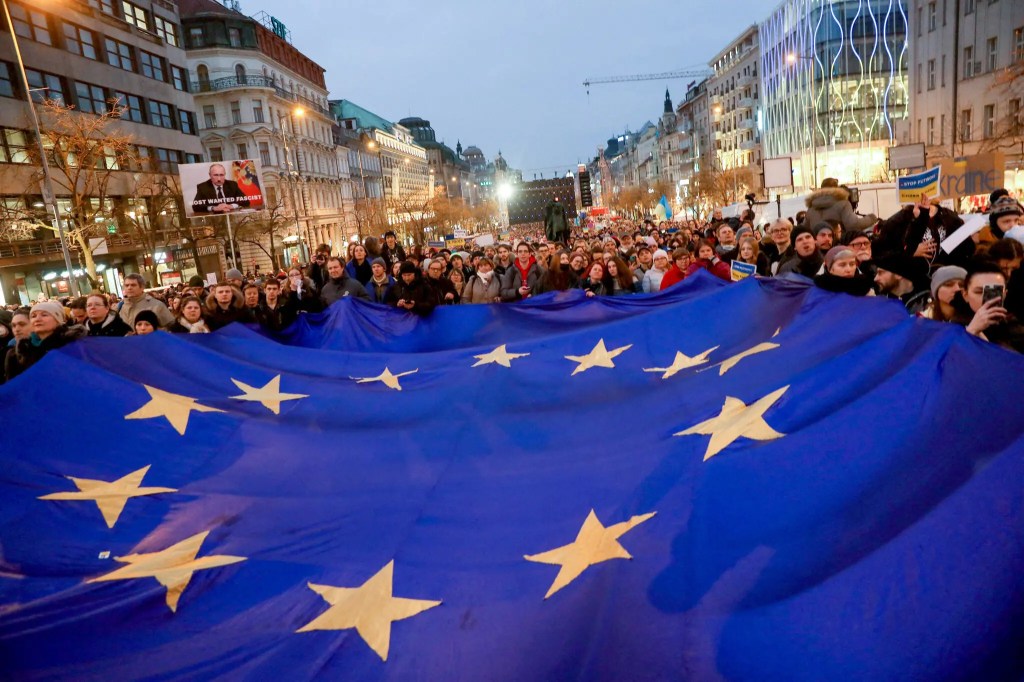
Professor Cross has been commissioned to write a book on European Union grand strategy, which is under contract in The Oxford Studies in Grand Strategies series at Oxford University Press. This book offers a globe-spanning, planetary perspective on how and why the European Union has deeply mattered to world order in the 21st century. Mai’a K. Davis Cross argues that despite often flying under the radar, long-standing European global strategies have permeated the very fabric of the international system, upholding strong norms of stability, liberalism, and social consciousness from the deep sea to outer space. With a fresh perspective on grand strategy, this book uses an interpretivist lens to argue that EU grand strategy is designed both to address global transformations as well as to reflect political culture, historical memory, and visionary leadership within society. For the EU, grand strategy is not so much about pursuing a position at the top of the international hierarchy, but about shaping the international environment itself. To do this, alongside relying on traditional sources of power, the EU builds on social power in the form of transnational networks, the power of possibility, and consistency of values, even in the face of crises. Overall, European Union Grand Strategy reveals the EU’s planetary impact through an analysis that crosses space and time from frontier technologies to human rights, from energy infrastructure to space exploration, EU activities are at the heart of much of what will sustain our planet over the longer-range future. In this deeply interconnected yet fragile world, it is time to move away from evaluating grand strategy for its achievement of national self-interest, and instead towards its capacity to safeguard the future of humanity. In this regard, the EU is the indispensable actor.
 Mai'a Keapuolani Davis Cross